
HOW DO WE CHOOSE COMPASSION OVER SELF-PRESERVATION?
The natural inclination to come alongside each other and offer connection is compassion. “To be with”  is the definition of compassion. However, when we are frightened, unsafe, disconnected, we have to work harder to find this natural response because our self-preservation becomes more prominent. Christiana Figueres spoke these words recently at a talk she gave at the Upaya Zen Center’s Awareness in Action: Engaged Buddhism programs. This one was about Climate Action but so much more! You can read more about Christiana here.
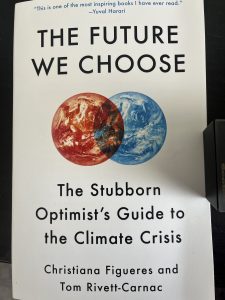
In 2014, Figueres was asked by UN Secretary General Ban Ki-moon to assume the role of key negotiator after a disappointing experience at the talks in Copenhagen. Christiana took on this powerful role, but as she says in her book, The Future we Choose, (2020), she had to change her own attitude first. After Copenhagen, the future seemed bleak and it was a pervasive feeling among negotiators and countries that a global climate agreement couldn’t be made. In order to lead others in moving past their hopelessness to bringing a new mindset forward, she knew she had to be “the beacon of possibility that would allow everyone to find a way to a solution together.” As she was on the road to collaboration to build this agreement, she learned how critical optimism is to transformation.
She says,
“We clearly have to move from fear, paralysis and disbelief to pathways of connectedness and kindness. How do we do this? We have to practice leadership, to create leadership that creates care and safety for ourselves and others.… It isn’t about fixing what’s broken, it’s about nurturing our wholeness. We can be sure that kindness becomes a renewable resource. “ “Pathways of connectedness and kindness” sounds like compassion to me —compassionate thought and action.
These words are very powerful to hear. Let’s take a moment to let them resonate inside of us. ……………….We do have the power to take action for ourselves even as the world seems to be exploding in front of us. This can apply to our state of the climate as we push beyond our 2.0 Celsius (2.7 Fahrenheit) that was the maximum we could reach before we were beyond what we could bring under control. Her warning and statements are so very clear:
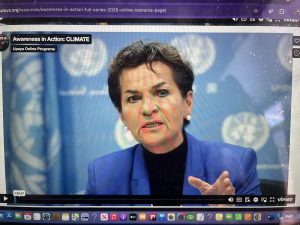 We have a choice. We have a 50% chance of turning this around. We must cut global emissons to half their current levels by 2030, half again by 2040 and to net zero by 2050 at the very latest. This is very possible if we provide the “stubborn optimist” steps to getting there. That is what her book, The Future we Choose is all about, written in 2020 about this process of being in this role of the driver of the Paris Climate Agreement and how it taught her so much about the transformational power of optimism. She proposes that we shift our attitude from being overwhelmed with hopelessness to focusing on the good news of what is happening and taking action there. She says we have to change our attitude to one of seeing what is possible and making that happen—this is stubborn optimism. We have no choice but to choose a future of making this transformation in our energy future happen.
IS STUBBORN OPTIMISM THE PATH TO COMPASSION?
This is where Buddhism (the Buddha actually first saw this in his observations of the mind) and/or modern neuroscience shows us that we can change our attitudes by first identifying our thought patterns and then deliberately cultivating a more useful and compassionate approach. An approach that expands our view to seeing ourselves as a part of all humanity and our interdependence on each other for life and love. In my work with women on my “Midlife Voyage to Transformation” path, I have presented the key to getting through grief and pain as choosing to go into it, turning towards and into your fear with fierce compassion, curiosity and self-love. The only way we can do this is to acknowledge that we have resistance to difficult things as human beings and that when adverse events are happening it is natural for us to feel overwhelmed, helpless and paralyzed (this is self-compassion). If you have been through any major trauma or event in your life that was life-changing, you know what I’m talking about. In order to get out of this paralysis, you have to work with your mind and begin to shift it from fight/flight/freeze to a different response.
Christiana says: “You can do it. You can switch your focus, and you will be stunned by the impact such a shift can create. You don’t have to have the answers, and you don’t have to hide from the truth. Nor should you. When you are facing the hard realities, look at them with clarity, but also know that you are incredibly lucky to be alive at a time when you can make a transformative difference to the future of all life on Earth.”
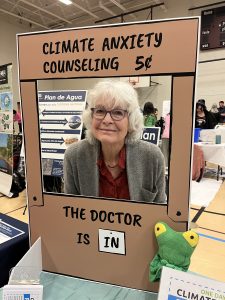
This is the mayor of Longmont, CO offering information and support to folks looking for what to do to help their hopelessness about the climate crisis. 2024 Earth Day.
WHAT DOES COMPASSION HAVE TO DO WITH CLIMATE ACTION?
When you take action with yourself, as in changing your focus and deliberately choosing to go into your fear and hopelessness, you are getting in touch with the deep compassion we all humans hold inside of us. We dive deeper into our own compassion container where we can hold ourselves and get re-charged to take the next step. You fortify yourself in this process. Some have called this “Fierce Compassion.” (Kristin Neff, https://www.youtube.com/watch?v=JVgb9yXeVCY
You feel your interconnectedness to all living beings because this loving force inside of you is all around you also. By feeling your deep connection to the life force, all living beings, you are moved more deeply to keep expanding your compassion for yourself and others. This is empowering. It has opened up a huge reservoir inside of me to take more action and to guide others to do this. I find that when I am taking action I feel more alive and more peaceful, contented and calm. I can feel the connection with my heart and my body and how I can offer more compassionate presence into the world.
COMPASSIONATE ACTION OF ANY KIND CAN BRING A MORE COMPASSIONATE WORLD
It starts with you and me. We have to do our own choosing to guide our focus, to shift our attitudes to one of curiosity, compassion and optimism, because in the end, we are saving ourselves and the world in the process. You can call this global self-preservation through individual and mutual compassionate action.
Christiana offers these steps to an Optimistic Mindset that you can use to work with your mind in changing focus:
1) To be optimistic, you must acknowledge the bad news but still move yourself to focusing on the good news. In other words, Optimism is about being able to intentionally identify and prescribe the desired future so you can actually pull it closer. This is about having a positive vision about the future, ie, We can do this!
2) Looking broadly forward with this kind of optimism at the future allows you to risk and allow for mistakes, delays and disappointments. You have buoyancy.
3) Optimism empowers you; it drives your desire to engage, contribute and make a difference.
4) Optimism is about having steadfast confidence in our ability to solve big challenges as human beings.
5) Optimism is about actively proving, through every decision and every action, that we are capable of designing a better future.

