
 I just returned from Florida from visiting my closest sister whose life just changed dramatically. Wheww! It’s really difficult when it comes close to home. You have been there too. When it is your own family experiencing life-changing accidents that impact your loved ones’ role from spouse to caregiver, that’s big. Caregiving and aging often go hand in hand, and as I am experiencing friends and family needing more caregiving in my life now, the emotional support and care they sometimes don’t know they need becomes an opportunity for our compassion containers to grow.
What I am finding about these kinds of situations is that personal storytelling can be an amazing antidote to “helping” words, advice or fixing. When we tell our stories, sharing what we went through and how messy it was for us, it often helps release a tiny edge of the pent-up emotions that are being pushed back in order for the caregiver to cope, to hang on for dear life. And it is about survival, finding yourself with a totally new life that you never expected nor imagined. Through offering our stories, we can often find a way to give comfort and love in a way that it can be received, which can soften the burden gently.
Some of us might be feeling similar feelings about our political struggle to find direction right now. How do we balance our personal lives in a scary world that is collapsing before us? In a similar way, we cannot talk to anyone about our fears and anger when we have not given ourselves a chance to process what is churning inside of us. We cannot move forward until we attend to ourselves.
 Tanja Pajevic, my memoir writing Coach, shared in her monthly newsletter a similar message, “Can Stories help us Navigate our way Forward?” In her post she quoted Kurt Gray’s “Tell Your Story” (author of Outraged:Why We Fight About Morality and Politics and How to Find Common Ground,”) in which he states:
“Stories are the most powerful when they revolve around suffering, because pain, worry, and fear are experiences all humans have in common. These stories of vulnerability help bridge the gap between minds: We might recognize—in the abstract—that other people can feel like we do, but hearing their concrete experiences of harm allows our imaginations to resonate with their inner life.”
Our imagination comes from our creative, intuitive, and spiritual parts of ourselves. These are the inner parts that stories can open up for us. Tanja also speaks to how spiritual messages help us get deeper into ourselves, our hearts, and can help us to connect with each other as human beings. All of this resonates with my own personal experience of writing my own memoir about my difficult midlife events. It has brought me to a deeper, more compassionate place where I am more able to withstand and hold grace when waves keep crashing. But not without alot of deep mindfulness practice and staying with myself throughout the caregiving.
 Stories, whether they are our stories, our friends’ stories, the Goddess myths and parables of spiritual origin from generations before us; they have helped all of us to get out of our minds and into our bodies and hearts. When we feel we are in danger, stressed, frozen in fear, we can only unlock our deeply armored hearts with warm human connection. But often that is even scary to open up any vulnerability. Trauma research has shown us that this is the way we shift our nervous systems out of fight flight—by deeply activating our vagus nerve located in the center or our chest—this is our social self. Then we feel connected to someone else we can re-balance and restore our wellbeing. This happens through our bodies, not our minds.
Here is an example of how you might offer your story is when you are listening to a special friend who is “toughing it out” by denying she’s hurting and pushing through it creating suffering for herself and others. At the right moment you could offer your personal suffering story maybe just to the point where you were feeling just like your friend. Let her offer if she’s interested in hearing how you got through to the other side and what helped you, and even what you learned from it. We call this kind of a story a “silver lining story” taken from the English proverb, “Every dark cloud has a silver lining.’
When your loved one or best friend is stricken with a major challenge, can you draw upon your Compassionate Self who knows you are hurting deeply with her/him? Before you do anything, mindfully check in. Can you resist giving advice and simply listen? Can you notice your own emotional turmoil that is being triggered and hold yourself steady? Can you offer a story about you that might be helpful to this person in this moment? Can you love yourself deeply no matter how much you stumble?
Roshi Joan Haifax at the Upaya Zen Center in Santa Fe has developed a training program for Caregivers and Healthcare workers, Doctors and Therapists called G.R.A.C.E. It builds the capacities internally to cultivate stability and conscientiousness in the midst of radical uncertainty. Most of what I’ve stated above comes from my participation in this program which is available twice a year through Upaya Zen Center. This program has been taught over the past 4 years during and after Covid and has been incorporated by Roshi’s protege into a powerful guidebook for medical practitioners called Inner Medicine Practice by Wendy Lau, M.D. This book deeply addresses what compassion means in practice and how to address moral outrage and moral apathy in these professions. It addresses how to build moral resilience and compassionate care in a crazy world.
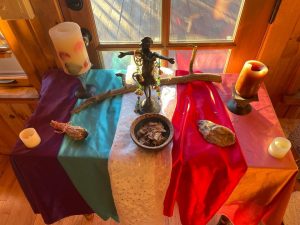 This month, my Practice suggestion for you is to prepare for this situation as it is upon you. Practice TELLING YOUR STORY. Daily Journaling can be really helpful in helping your process your feelings as you figure out what might be going on in your mind and body. We can’t really know until we take the time to check-in with ourselves. When you write down or tell someone what you are feeling, two things happen:
1) You feel and release emotions that need to be released and you get clarity often from this process.
2) You feel connected to something or someone other than yourself – you are not alone. Here’s where healing begins.
When you journal in a personal journey just for you, it helps you to get a little distance from all the “voices” blasting inside of you. Or, it gives you quiet space to allow something to be felt that has been pushed down deep. The Journal has become your Witness. Slowing down to create this warm connecting silence and stillness can be the deepest healing love you can find when things around you are building up and feeling intense. Then, you can begin to share your story or experience from this deeper wiser place inside of you. A place deeply seated in your Compassion Container ready for easy access whenever you need it.
I share many Journaling Prompts, Mindfulness Practices and Exercises that can be very helpful for balancing your mind and body and nervous system in my memoir and Companion Workbook. These tools allow you to start and complete your healing process. This bundle of books is available here on my website.
Tanja offers a powerful toolbox for getting started with writing your story. Memoir writing is one of the most powerful ways to tell your story for connection and sharing. If you are interested in taking this into a healing journey for yourself, or just to explore this option, here’s the link for her STORY STARTER KIT.

