
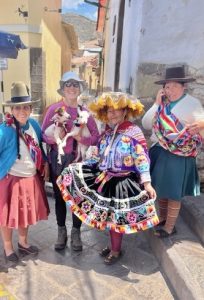
 Oh, I’m so glad that happened! I’m filled with gratitude as I just got back from 12 days in Peru where I had the wonderful once-in-a-lifetime opportunity to hike the Inca Trail with my son and my partner. The people of Peru, descendants of the Inca, are so warm and welcoming. Even though they often engage in transactional relationships, they want to connect and learn about us and in that exchange they get our witnessing and it feels good to us as well as them. I feel warm peacefulness and calmness in mind and body that I didn’t feel before I left. I have a powerful opportunity to savor these positive experiences and use them to bolster my resilience and expand my compassion-container this election season. Why? Coming back to the intensity of our current political state and the ongoing poly crisis of climate change, hurricanes, racial turmoil, othering, war and devastation happening in our country as much as in other parts of the world. We are in the crisis! It is all around us.
Gratitude is an opening of warmth and love — an uplifting sense of joy — which orients us to goodness and abundance. Gratitude brings us back in touch with our strengths and helps us feel a deep connection to all living beings or to nature’s bounty that we have in every moment. And, when we are experiencing challenges in our lives, gratitude can bring us back to our wholeness and a new perspective for hope and re-connection in our lives.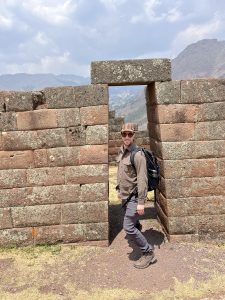
I have always been looking for ways to “switch the channel” of my brain in order to counteract the negativity that naturally shows up for me. After all, our brains are programmed by our evolutionary growth to help us find danger and scan for it. In a world of today, always looking for danger isn’t very helpful. We need tools to help us shift our perspective, no matter what might be going on in our lives—pleasant, unpleasant and neutral. We need gratitude to re-balance and unblock our conditioned responses to our intense world.
GRATITUDE BUILDS WELL-BEING BY GROWING YOUR SELF-COMPASSION CONTAINER
Joanna Macy, author of Active Hope, How to Face the Mess We’re in without Going Crazy, shows through her healing model for dealing with social and ecological collapse in our world that Gratitude is where we start and end. Gratitude defined by psychologist Robert Emmons is “A sense of wonder, thankfulness, and appreciation for life.” Gratitude adds “psychological buoyancy that helps you maintain balance in rough waters.” (p. 43) Generally speaking, Gratitude promotes a sense of well-being. Controlled trials on writing Gratitude Journals shows that they have a profound effect on changing our mood. Writing before you go to be each night about “what happened today that I’m proud of or thankful for?” directs us to glows of self-appreciation.
Joanna says there are 2 sides of gratitude: Appreciation, where you’re valuing something that has happened or valuing yourself directly; and Attribution, where you are recognizing the role of someone or something else in bringing it about. Being grateful to yourself hits both of these and builds your self-compassion container. I am realizing as I practice self-compassion in my daily life that self-appreciation is often the way that I move out of negative thinking, judgment and self-judgment. I learned from working with my teacher Deborah Eden Tull, author of Relational Mindfulness and Luminous Darkness that adding a Practice of Self-Appreciations daily worked powerfully to bring me back into balance and self-compassion when I was dropping into depressive moments. When we savor or stop to notice and feel more deeply our positive experiences, we generate self-appreciation and self-compassion. Self-appreciation helps us see our Common Humanity, therefore we don’t take everything personally. Our good qualities are often the result of many favorable situations in our lives as well as our contact with many people. We realize with our Common Humanity that we are connected to everyone else and we don’t feel separate or better than others.
Our Attribution becomes everyone and everything that has brought us to this moment. 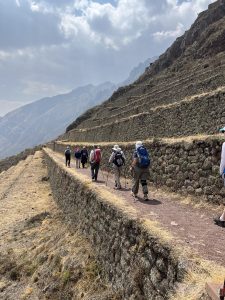
In the same way, when I am feeling grateful, I don’t get lost in my sadness or feelings of “poor me”. I can see that gratitude can be a breakthrough to a higher view, a bigger picture of the reality of life being filled with both positive and negative experiences and that I can apply my strengths within to help me cope with the more difficult moments. Gratitude helps me hold and see my own wholeness.
GRATITUDE BUILDS TRUST AND GENEROSITY AND MOTIVATES US TO TAKE ACTION FOR OUR WORLD
Gratitude builds trust and generosity. It helps us acknowledge the times we’ve been able to count on one another. Think about how this can help us find a new way to relate in our present world. Actually, research shows that we’re more likely to help those we feel grateful to, leading to a positive spiral of helping, gratitude, trust and cooperation. So our political candidates that we feel are grateful, show gratitude and feel trustworthy, can play a key role in awakening a deeper connection with generosity and good will. Gratitude influences our readiness to to help others. Gratitude builds trust and collaboration. Our ability to connect peacefully is impacted by our level of gratitude.
As we move into our month of Gratitude with Thanksgiving, we can explore how this practice of Gratitude can motivate us to act more for our world in a larger context of healing. Ponder these questions:
—Why were the Indigenous people of our country so grateful? The Haudenosaunee people regard gratitude as essential to survival. See the Iroquois Confederacy and Haudenosaunee Address
—How did they practice gratitude with Mother Earth? How did gratitude give them support and guidance in their lives?
—Why do we practice Gratitude at Thanksgiving? What are you thankful for?
 Take this question into your Sacred Space this month and explore how gratitude can give you the buoyancy to take action to build trust, collaboration and generosity this election season! Move out of us and them and move into one-ness, as in all of us working together for goodness. I offer this Practice now so that you can take in the benefits of your Gratitude Practice for longer than a few days in November. Besides, as you practice gratitude, notice how it switches your attitude to an expanded sense of self and counteracts the Me-orientation of our culture. How do you want to live each day?

